HNS Gold

Free Gold Valuation
Toll Free1800 212 5600 · Free gold valuation

8 Jeweller Tricks to Know Before You Sell Gold in Kolkata

Picture this. You’ve got a pair of old bangles that were your mother’s, and you’ve finally decided to sell them. The jeweller rubs one on a black stone, puts both on a scale that’s turned towards him, punches something into a calculator and tells you a figure. He doesn’t explain it. You don’t ask. In some shops it goes a step further. The bangles get melted before you hear any price at all, and after that, saying no isn’t really on the table.

sell gold in Kolkata

If you’ve ever tried to sell gold in Kolkata, you’ve probably been through some version of this. Most of us take the offer because we honestly don’t know how old gold is priced, or we assume every shop will say roughly the same thing. They won’t. Below are eight things some jewellers do that leave you with less than your gold or silver is worth, and what a fair valuation is supposed to look like, so you know what to ask for next time.

Why Gold Valuation Often Feels Like a Black Box

Old gold is priced on three things: how pure it is, how much it weighs once stones and other bits are taken out, and what pure gold is selling for that day. Put together, the calculation looks like this:

Value = Net weight (grams) × Purity (%) × Today’s 24 karat rate per gram

Nothing complicated about the maths. The trouble is that sellers rarely get to see the three numbers that go into it. Purity gets “estimated”. The weight is read out to you. And the rate is whatever the shop says it is that morning.

A quick refresher on purity, since the numbers stamped on jewellery confuse a lot of people:

  • 24K is about 99.9% pure gold, often stamped 999
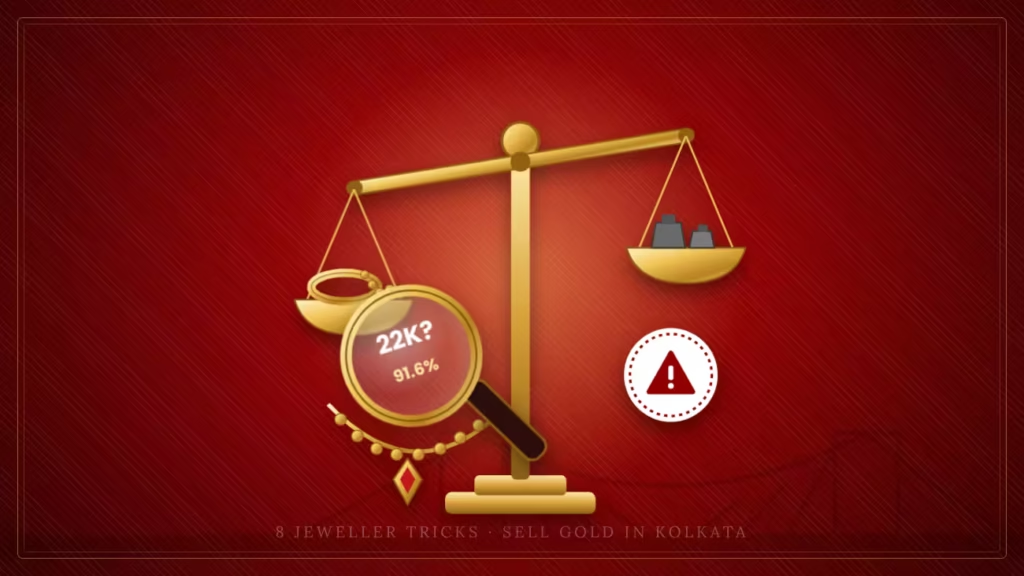
  • 22K is 91.6% pure and usually stamped 916. Most Indian jewellery is 22K
  • 18K is 75% pure, stamped 750
  • Fine silver is 99.9% pure, while sterling silver is 92.5% (you’ll see 925 on it)

None of this means every jeweller is out to cheat you. There are shops in Kolkata that have looked after the same families for forty years without playing a single game. But when the whole thing happens behind the counter with nothing written down, a few thousand rupees can easily go missing from your side of the deal, and you’d have no way of spotting it.

8 Tricks Some Jewellers Use to Underpay You

1. They guess the purity instead of testing it

“This looks like 18 carat.” You’d be surprised how often that one line decides the whole price. A touchstone only tells you about the surface of the metal, and the result depends a lot on who’s doing it. If your 22K chain gets called 20K or 18K, a big part of its value is gone right there, and nobody even had to open a calculator. So ask how the purity was checked, and what the exact number was.

2. They don’t let you see the scale

Weight is where money disappears most quietly. The scale faces the jeweller, the reading gets said out loud, and somehow 9.87 grams turns into “about nine and a half”. Scales used for buying and selling in India are meant to be checked and stamped under legal metrology rules. You’re well within your rights to lean over and look at the display yourself. A decent buyer will turn it towards you without being asked.

3. They quote a rate without saying which rate

“Today’s rate is this much.” Fine, but which rate? The 24K rate or the 22K one? The price they sell at, or the lower price they buy at? Plenty of people see one number on the news in the morning, hear a different one at the counter, and just assume they’ve misunderstood. You probably haven’t. Ask what the rate per gram is, which purity it’s for, and where it comes from.

4. They value everything as one lump

Say you bring in a chain, two pairs of earrings and an old ring that was your grandmother’s. Everything goes on the scale together and you get one figure back. The catch is that those pieces may not all be the same purity. The ring could be 22K and the earrings 18K, and once it’s all lumped together, it’s easy to price the whole lot at the lowest one. Ask for each piece to be valued on its own.

5. They push exchange instead of cash

Some shops will offer a “special” rate for your old gold, but only if you use it to buy something new from them. What they don’t mention is that the new piece comes with making charges and 3% GST, and those can quietly swallow whatever extra you were promised. If you actually want new jewellery, an exchange can work out fine. Just find out what you’d get in cash first, so you know what you’re comparing against.

6. They melt your gold first and tell you the price later

We hear about this one all the time. The buyer takes your jewellery, melts it “to check the purity”, and only then tells you the price. And at that point, what can you really do? Your necklace is a lump of metal now. You can’t wear it again, and carrying it to another shop for a second opinion feels a bit pointless. So people sell, even when the number feels wrong. Don’t let anyone cut, scrape or melt your gold until you’ve seen the valuation and agreed to it.

7. They rush you

“Rates are going down tomorrow.” “I can only give this price today.” You’ll hear lines like these, especially if you look a little unsure. Gold prices do change every day, that part is true. But a buyer who’s being straight with you will show you today’s rate, explain how they got to the offer, and be fine with you taking some time. If you’re being hurried, that’s usually your cue to slow down.

8. They treat your silver as if it’s worth nothing

Silver tends to get the laziest valuation of all. People hand over old anklets, puja utensils and coins and take whatever’s offered, because silver “isn’t worth much” anyway. It is, though. Silver has its own daily rate just like gold, and whether a piece is 999, 925 or something lower makes a real difference to what you should get. It deserves to be tested and weighed just as carefully.

Why People Still Accept a Low Offer

Even people who suspect they’re being underpaid often go ahead and sell anyway. In Kolkata, where so many families have bought from the same shop in Bowbazar or Gariahat for two or three generations, the reasons are usually very human:

  • It feels rude to question a jeweller your family has trusted for years.
  • There’s a hospital bill, school fees or a wedding coming up, and no time to go from shop to shop.
  • You’re not sure what 916 means, so it’s hard to argue about purity.
  • You figure there’s nowhere else to go. Of all the reasons, this is the one that simply isn’t true.

You have a right to know the real value

Selling your gold isn’t a favour anyone is doing you. It’s a deal, and you’re entitled to understand it. India’s Consumer Protection Act, 2019 actually spells this out: consumers have the right to be informed about the quality, quantity, purity and price of goods. If your jewellery is hallmarked, you can also look up its six-digit HUID code on the BIS CARE app, run by the Bureau of Indian Standards.

Honestly, a buyer who’s confident about their valuation won’t mind showing you how they worked it out. If they get uncomfortable when you ask, that tells you something.

What a Transparent Gold Valuation Looks Like

A fair valuation is one you can follow along with, sitting right there, without having to take anyone’s word for it. When you sell gold in Kolkata, this is roughly how it should go:

  1. Your gold is tested on a proper purity machine, and you’re shown the result.
  2. It’s weighed on a scale you can see.
  3. If there are stones or other non-gold parts, you’re told what they are and how much they weigh.
  4. You’re given the day’s rate per gram, and told which purity it applies to.
  5. You get a breakdown, on paper or on screen, showing how purity, weight and rate add up to the final amount.
  6. You decide. Sell, ask more questions, or take your gold back home.

How HNS Gold Values Your Gold and Silver

This is exactly why we set up HNS Gold the way we did. We’d rather you understood every number before you decide anything. If you’re looking for gold buyers in Kolkata who’ll actually show you their working, this is what a visit to us looks like.

Purity checked by machine, not by guesswork

We test your gold and silver on a German-made XRF gold purity checking machine. The machine reads exactly what the metal is made of, without scratching or melting it. The result comes up on the screen in front of you, so nobody at our counter is going to tell you it “looks like 18 carat”.

Weighing you can watch

Everything is weighed on a scale you can see. If a piece has stones or other bits that aren’t gold, we’ll point them out and show you how they change the net weight. Nothing comes off without you knowing why.

A rate you can understand

Our offer is based on today’s gold rate, and we take you through the calculation one step at a time: purity, net weight, rate. You’ll know exactly why the final number is what it is, and you’ll get a good, fair price for what your gold is really worth.

No melting, cutting or damage

We don’t melt, cut or scratch your jewellery to test it. It stays exactly the way you brought it in, so you’re never left holding melted gold and an offer you don’t like.

You’re free to walk away

And if the offer doesn’t feel right, don’t sell. Really. Take your gold home, sleep on it, check with someone else if you like. We’d much rather you leave happy than leave with a deal you regret.

Know the Numbers Before You Sell

Your gold and silver are worth real money, and quite often they carry real memories too. A purity guess here, a hidden scale there, gold melted before you’ve agreed, a bit of pressure at the counter, and a good part of that value slips away without you noticing. The way around it is simple. Ask to see the purity result, the weight and the rate, and don’t let anyone damage your jewellery before you’ve said yes.

If you want to sell gold in Kolkata and actually understand the offer in front of you, visit HNS Gold for a transparent valuation. Bring your questions along. Whether you end up selling or not, you’ll walk out knowing exactly what your gold is worth.

FAQ's

You can sell gold at jewellery shops across Kolkata or at specialist gold buyers. More than where you go, what matters is how they value it. Pick a buyer who tests purity on a machine in front of you, weighs on a scale you can see and explains the rate. That’s how we work at HNS Gold, and you’re always free to leave without selling.

Multiply the net weight by the purity, then by the day’s 24 karat rate per gram. So 10 grams of 22K gold has about 9.16 grams of pure gold in it, and that’s what you’re paid for. If anything is deducted, like the weight of stones, it should be measured and explained to you.

Start by looking for the BIS hallmark and a six-digit HUID code, which you can check on the BIS CARE app. For an exact figure, ask the buyer to test the piece on a purity machine and show you the reading. A touchstone rub only checks the surface, so it isn’t always accurate.

Yes. Modern purity testing machines can check gold without cutting, scratching or melting it. At HNS Gold, nothing gets damaged during testing. That matters more than people think, because once a piece has been melted or cut, you lose the option of walking away or getting a second opinion.

Yes. Silver jewellery, coins and utensils can all be sold. Don’t settle for a rough guess. Ask for the purity to be tested and the weight shown to you, just as you would with gold.

Usually a valid photo ID such as your Aadhaar card, along with your PAN card. Old bills help if you have them, but they aren’t always needed for family jewellery. Under Indian tax rules, larger amounts are generally paid by bank transfer rather than cash, so keep your bank details handy.

Of course. Getting your gold valued doesn’t mean you’ve agreed to sell it. You can ask questions, take time to think or compare with another buyer. A good buyer will respect that, and at HNS Gold you can always take your gold back if the offer doesn’t feel right.

Scroll to Top